
KEYS & CHORDS
Find a key from its signature
- 1Signature
- 2Major or minor
- 3Answer
Your key is…
A-sharp minor
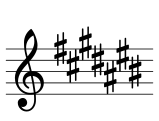
♯ 7 / Minor
Primary chords in this key
Key signature:♯ 7 / Root-position triads
Minor keys use the harmonic minor scale: the seventh degree is raised by a semitone. This may add an accidental beyond the key signature. The dominant (V) is a major triad.
Tonic
A♯m Minor triad
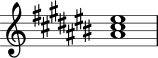
A♯・C♯・E♯
A♯4 · C♯5 · E♯5
The stable centre of the key, often heard at the beginning or end of a piece.
Subdominant
D♯m Minor triad
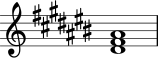
D♯・F♯・A♯
D♯4 · F♯4 · A♯4
Moves away from the tonic and opens up the harmony. It can lead toward the dominant.
Dominant
E♯ Major triad
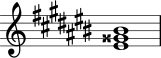
E♯・G♯♯・B♯
E♯4 · G♯♯4 · B♯4
Creates a pull back to the tonic. Listen to V followed by I to hear the resolution.
Hear the chords together
I → IV → V → I. Listen for the return to the tonic at the end.
Keep your device volume low when listening.
About note names and symbols
Note names use fixed-do pitch names. I, IV, and V are chords rooted on scale degrees 1, 4, and 5. Chord tones are listed from lowest to highest. The number after a letter identifies the octave; C4 is middle C.
A sharp raises a note by a semitone, a flat lowers it by a semitone, and a double sharp raises it by a whole tone. Different spellings can share a piano key, such as C-flat and B, or E-sharp and F. The keyboard and audio show the sounding pitches.
Further reading:Senzoku Online: Chord types / Yamaha: Scales and keys